HomeJuteAgroMarketsGuidesAboutContactRequest a Quote
Quality & Compliance

Licenses & Certifications

Big buyers buy on evidence. These are Zayin's actual export licenses, registrations and memberships. Certified originals are shared directly with verified buyers on request.

Verified documents

Our licenses, registrations & memberships

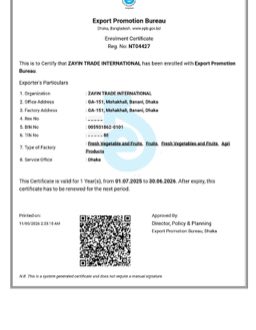
Export Registration, EPB, official documentExport Registration, EPBExport Promotion Bureau, Govt. of BangladeshConfirms Zayin as a registered, licensed exporter of Bangladesh.
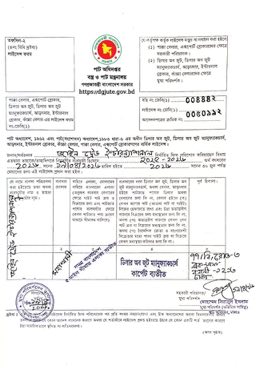
Jute Trade License, official documentJute Trade LicenseDepartment of Jute (Jute Adhidaptar), Govt. of BangladeshAuthorises trading and export of jute and jute goods.
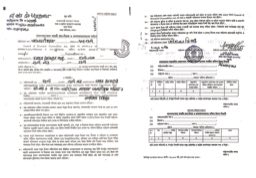
Food Grain Trade Licence, official documentFood Grain Trade LicenceDirectorate General of Food (DGFood), Govt. of BangladeshLicenses Zayin to buy, sell and store food grain under the Control of Essential Commodities Act, 1956.
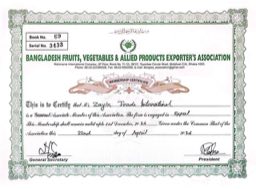
Fruit & Vegetable Exporters' Association, official documentFruit & Vegetable Exporters' AssociationBangladesh Fruits, Vegetables & Allied Products Exporters' Association (BFVAPEA)Member of the national fresh-produce exporters' body.
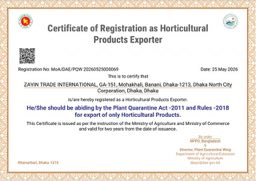
Horticultural Products Exporter Registration, official documentHorticultural Products Exporter RegistrationGovt. of BangladeshRegisters Zayin to export horticultural / fresh-produce products.
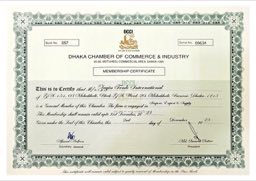
DCCI Membership, official documentDCCI MembershipDhaka Chamber of Commerce & IndustryMember of Bangladesh's leading chamber of commerce.

Low-resolution previews are shown for reference; certified full copies are shared directly with verified buyers on request. For audited product standards (ISO 9001, OEKO-TEX, food-grade VOT, GlobalG.A.P.), see the notes below, these are arranged on request and per order.

Standards Explained

What the Standards Mean and Why Serious Buyers Require Them

The certifications listed on this page are not marketing credentials, they are the due-diligence instruments that procurement teams, quality assurance managers, and compliance officers use to qualify suppliers. Understanding what each standard actually covers helps buyers assess supplier claims accurately and ask the right questions during vendor onboarding.

Zayin Trade International works to the standards below across our jute and agro divisions. Where certificates are available for download or on request, this is noted. Where a standard forms part of our compliance roadmap or is available for specific product lines on request, we say so clearly. We do not claim certifications we do not hold.

Jute Division, Applicable Standards

Jute Product Certification and Quality Standards
VOT Food-Grade Declaration
(IJO 98/01 / ECF–ECA Spec 2026)
Confirms jute bags are processed with vegetable oil (rice bran or castor) rather than petroleum-derived Jute Batching Oil (JBO). Petroleum-based mineral oil residues, MOSH and MOAH, can migrate into packaged food commodities and are regulated under EU Regulation EC 1935/2004 on food contact materials. The IJO 98/01 standard uses an unsaponifiable matter (USM) limit of 1,250 mg/kg as a proxy measure. The February 2026 ECF/ECA Joint Industry Specification for cocoa and coffee bags now sets direct MOSH/MOAH limits (MOSH max 250 mg/kg, MOAH max 25 mg/kg), which is the emerging market standard for European food-chain buyers. VOT bags are visually identified by three blue stripes. Status: food-grade VOT declarations and migration test reports available on request for applicable product lines.
ISO 9001 Quality Management SystemCertifies that a manufacturer operates documented quality management processes, covering raw material intake, production procedures, non-conforming product controls, internal audits, and customer complaint systems. ISO 9001 does not certify the product itself; it certifies that the processes producing it are systematically controlled. For buyers, it is the baseline that underpins the credibility of all other product documentation. Status: available on request.
OEKO-TEX Standard 100A product-level certification testing every component of a textile article, fabric, threads, dyes, finishes, against 1,000+ restricted substances, including pesticide residues, heavy metals (lead, cadmium, chromium), banned azo dyes, formaldehyde, PAHs, phthalates, PFOS/PFOA, and chlorinated phenols. Limit values are calibrated to EU REACH Regulation (EC) 1907/2006 restrictions and the ECHA SVHC candidate list. Certificates are renewed annually and are verifiable in real time via the OEKO-TEX Label Check portal using the certificate number. For EU buyers, OEKO-TEX functions as a practical REACH compliance proxy. Status: available on request for applicable product lines.
SEDEX / SMETA Social AuditSEDEX (Supplier Ethical Data Exchange) is the platform; SMETA (Sedex Members Ethical Trade Audit) is the audit methodology. The standard 2-pillar audit covers Labour Standards (wages, overtime, child labour, forced labour) and Health & Safety (fire, PPE, emergency systems). The 4-pillar version adds Environment and Business Ethics. The deliverable is an audit report uploaded to the SEDEX platform, not a certificate, shared with multiple linked buyers simultaneously. One audit discharges the ethical trade due diligence requirement for many buyers at once. SMETA is the most widely accepted mechanism for satisfying EU Corporate Sustainability Due Diligence Directive (CSDDD) obligations. Status: part of our compliance roadmap, documentation available for buyer enquiries.
SGS / Bureau Veritas Pre-Shipment InspectionThird-party inspection at origin verifying quality, quantity, and specification compliance before goods leave Bangladesh. For jute, physical tests include: tensile and seam strength, moisture content (optimal 12–14%; excess causes fungal growth and weight misrepresentation), weight per unit area (GSM), load-bearing and drop tests, and AQL sampling for visual and dimensional defects (typically AQL 2.5 major / AQL 4.0 minor). For food-grade bags, hydrocarbon testing by gas chromatography. Inspection reports are commonly required for LC payment release and serve as primary legal evidence in disputes. SGS Bangladesh operates a dedicated Jute Grading and Testing service at Chittagong. Status: third-party PSI available on all jute orders, buyer-nominated inspectors also accommodated. Inspection costs typically for buyer account.
REACH (EC 1907/2006) ComplianceEU regulation governing chemical substance safety in manufactured goods sold into the EU. Annex XVII restrictions on azo dyes apply to jute bags as textile articles, aromatic amines released by azo dyes must not exceed 30 mg/kg. OEKO-TEX Standard 100 certification satisfies REACH compliance as a bundle; alternatively, individual migration test reports from accredited laboratories (Eurofins, SGS, Intertek) can be supplied. Status: REACH-compliant documentation available on request for EU-destined orders.
EC 1935/2004 Declaration of ComplianceEU regulation on food contact materials requires that packaging contacting food must not transfer substances endangering human health or cause organoleptic changes. No harmonised EU measure exists specifically for natural fiber packaging; jute bags are assessed under the general safety obligation. Exporters support compliance with a Declaration of Conformity backed by third-party migration test reports. Status: declarations and supporting test reports available on request for food-grade / VOT product lines destined for EU markets.

Agro Division, Applicable Standards

Fresh Produce Certification and Compliance Standards
Phytosanitary CertificateAn official government document issued by Bangladesh's Plant Quarantine Wing (PQW), Department of Agricultural Extension, Ministry of Agriculture, certifying that a consignment is free from regulated pests and diseases and meets the importing country's phytosanitary requirements. Governed internationally by the International Plant Protection Convention (IPPC) and WTO-SPS Agreement. Mandatory for EU market access under Regulation (EU) 2016/2031 and for all GCC member states. Status: phytosanitary certificates are issued on every fresh produce consignment as a standard requirement.
GlobalG.A.P. (IFA Fruit & Vegetables)The leading private-sector standard certifying agricultural production and post-harvest handling. The Integrated Farm Assurance (IFA) Fruit and Vegetables standard covers food safety, environmental sustainability, worker welfare, and traceability from pre-harvest through packing. The Produce Handling Assurance (PHA) standard specifically covers packhouse operations. Critically, the post-harvest and packing module requires that packaging materials used for certified produce must not contaminate the product, creating a de facto food-grade jute bag requirement for GlobalG.A.P.-certified producers. Required as a gateway standard by EU supermarket buyers and increasingly requested in GCC premium produce channels. Status: part of our agro compliance pathway, documentation and status available on request.
HACCP / ISO 22000HACCP (Hazard Analysis and Critical Control Points) is the systematic science-based food safety framework required by EU law under Regulation (EC) 852/2004. ISO 22000:2018 integrates HACCP with ISO 9001-style management systems and explicitly covers producers of packaging materials as part of the food chain. FSSC 22000 (ISO 22000 plus ISO/TS 22002-4 for packaging manufacturing) is GFSI-benchmarked and the most widely accepted food packaging certification globally. Status: available on request, applicable to fresh produce handling and processing lines.
Halal CertificationCertification that products comply with Islamic law requirements under GSO 2055-1:2015, the GCC-wide Halal food standard. For GCC buyers, Saudi Arabia requires certifying bodies endorsed by SFDA (Saudi Food and Drug Authority); UAE requires certification from ESMA-approved bodies only, self-declarations are not accepted. Natural jute fibre is inherently halal-compatible in principle, but formal certification from an accredited body is required for food-adjacent packaging exported to GCC food-chain buyers. Status: available on request for GCC-destined consignments; certifying body confirmed per destination country.
GCC Import Conformity (SASO / ESMA)Saudi Arabia requires a SASO Certificate of Conformity via the SABER platform for all product shipments. UAE requires ESMA conformity certificates for food contact materials. These are mandatory regulatory entry requirements, not optional due diligence. Our GCC market team can advise on specific product-category requirements at the quote stage. Status: standard component of GCC export documentation, included in all GCC-destined shipments as required.
Due Diligence Support

How Zayin Supports Your Vendor Qualification Process

Qualifying a new supplier for large-volume international purchasing involves more than reviewing a website. Most buyers need a structured documentation package, and most of the time, suppliers make this harder than it needs to be. We are built to make it straightforward.

For jute buyers in Europe and the UK, our standard qualification support includes:

  • Company profile with EPB registration reference (verifiable at epb.gov.bd)
  • Product-specific technical data sheets with confirmed GSM, weave, dimensions, and treatment type
  • Food-grade VOT declarations and supporting migration test reports for applicable product lines
  • Certificate documents for ISO, OEKO-TEX, and SMETA audit reports, current status on request
  • Third-party inspection arrangement via SGS, Bureau Veritas, or buyer-nominated inspector
  • REACH-compliant chemical test reports for EU-destined textile goods

For GCC buyers, we additionally support SASO/SABER documentation, ESMA conformity, halal declarations from approved certifying bodies, and phytosanitary cover on all agro consignments.

If your procurement team has a specific supplier questionnaire or pre-qualification form, send it to us directly. We will complete it and return it with supporting documents. Contact details are on our quote page, responses within two hours during business hours.

FAQ

Certifications: Common Buyer Questions

What is the difference between VOT and standard jute bags, and why does it matter for food packaging?

Conventional jute bags are processed with petroleum-derived Jute Batching Oil (JBO) during fibre softening. MOSH and MOAH, mineral oil hydrocarbon compounds, can migrate from JBO-treated bags into packaged food commodities. These substances are regulated under EU food contact materials law (EC 1935/2004) and represent a documented food safety risk in coffee, cocoa, cashew, grain, and rice supply chains. VOT (Vegetable Oil Treatment) bags use rice bran or castor oil instead, eliminating the mineral oil migration pathway. The IJO 98/01 standard and the more stringent February 2026 ECF/ECA Joint Industry Specification govern maximum allowable limits. For any food-contact application, VOT specification is the correct starting point.

Can Zayin provide OEKO-TEX certified jute bags?

OEKO-TEX Standard 100 certification covers the absence of 1,000+ harmful substances and is renewable annually per product line. We can supply documentation on our current OEKO-TEX status on request. If your order requires OEKO-TEX certification for a specific product, raise this at the quote stage so we can confirm the applicable certificate for that product line before you proceed.

Do you offer pre-shipment inspection and how is it arranged?

Yes. Pre-shipment inspection is available on all jute orders via SGS Bangladesh, Bureau Veritas Bangladesh, or a buyer-nominated inspection company. The buyer typically arranges and pays for inspection; we facilitate access at the mill. Inspection scope, AQL sampling, moisture testing, GSM verification, dimensional checks, hydrocarbon testing for food-grade bags, is confirmed in the inspection instruction letter before production completion. Inspection results are required as part of our standard LC documentation package where specified by the buyer's bank.

What social compliance audit standard do you work to?

SEDEX/SMETA is the primary social compliance audit framework we work to, aligned to the requirements of European retail and commodity buyers and the obligations of the EU Corporate Sustainability Due Diligence Directive (CSDDD). Current audit status and SMETA report availability are confirmed on request. If your company requires a specific alternative audit methodology (BSCI, amfori, etc.), raise this during qualification and we will advise on availability.

Which certifications are mandatory for fresh produce exports to the EU and GCC?

For EU-bound fresh produce: a phytosanitary certificate from Bangladesh's Plant Quarantine Wing is mandatory on every consignment under EU Regulation 2016/2031. HACCP-based food safety management is a legal requirement in EU food chain operators under Regulation 852/2004. GlobalG.A.P. is not legally mandated but is effectively required by major EU supermarket buyers as a procurement gateway. For GCC-bound produce: phytosanitary certificates are mandatory across all GCC states; halal certification from SFDA-approved (Saudi Arabia) or ESMA-approved (UAE) bodies is required for food-adjacent packaging; SASO/SABER conformity applies for Saudi Arabia. Our agro division page has further detail by destination market.

07 Request a quote

Send your spec. Get a real quote within 2 hours.

  • Specs, MOQ, pricing and lead times. Clear numbers, no runaround.
  • Talk to a specialist for your division & market.
  • Samples and certificate documents on request.
Zayin Group
House 29 (D2), Road 09, Block-G, Banani, Dhaka-1213, Bangladesh
Phone: +880 2 5504 2274 · +880 1711 979951
Email: sales@zayingroup.com

Get a Quote

Short on purpose. Branches by division.

Prefer chat? Message us on WhatsApp →